Tuesday, August 10, 2021

Doug Funnie: From Nickelodeon To Disney

In the entertainment business, cartoon characters are treated as real celebrities and public figures with full careers and accolades to match.

When Doug Funnie was 11 years of age he became the star of his own television series self-titled Doug. The relatability, coming-of-age narrative, quirky imagination, catchphrases, social commentary, spin-offs, and merchandise all contributed to the success of the show and his significance in pop culture. He has had an interesting rise to fame and career in the entertainment industry.

The year was 1991 and the show premiered on Nickelodeon on August 11 alongside Rugrats and The Ren & Stimpy Show as the channel's first original animated content known as Nicktoons. The history making debut made Doug an television icon and a breakout star of the '90s.

Executive produced by Jim Jinkins under the Jumbo Pictures production company, the shows pilot Doug Can't Dance, proved to be a big hit with executives at Nickelodeon and the rest is history.

Doug was As Told By Ginger before As Told By Ginger was As Told By Ginger. Doug himself narrates each story in his journal as a recurring theme in the series. The show also incorporates many imagination sequences along with addressing numerous topics, including trying to fit in, platonic and romantic relationships, self-esteem, bullying, and rumors.

The show went on to be nominated for two Daytime Emmy Awards by the time the show ended it's 4th season in 1994.

The original run consisted of 52 episodes over four seasons that were broadcast from 1991 to 1994. Nickelodeon opted against renewing the show for a fifth season.

In turn, The Walt Disney Company purchased ABC while also purchasing Doug in a multimillion-dollar deal in 1996. The deal involved buying Jumbo Pictures and "signing them to five-year contracts, with stock options, to be Disney executives." The company also purchased the Doug trademark and its rights to all future merchandising. Nickelodeon was allowed to retain the rights to the episodes produced from 1991–1994. Viacom’s chairman at the time, Sumner Redstone, wasn’t happy that Walt Disney had acquired the show.

Many original staff members of Doug regard the Disney run as inferior to the Nickelodeon run. With Disney, the show moved to ABC's Saturday morning programming block lineup for three more seasons, where it became a top-rated show, inspiring books, merchandise and a live stage musical. In its first season, the renamed “Brand Spanking New Doug” series (since called Disney’s Doug) became the block's cornerstone. In its second season, it’s a key contributor to making the network No. 1 in Saturday morning ratings.

The show's last episode aired in June of 1999 after 7 seasons being nominated for two more Daytime Emmy Awards and a theatrical feature, Doug's 1st Movie, released as the series' conclusion. It was predicted that if the movie was a success, the Doug franchise could be worth more than $100 million to Disney. However, this did not happen. With a budget of five million, the film underperformed previous expectations grossing less than twenty million at the box office.

Douglas Yancey Funnie's birthday is said to be on August 22, 1981. Depending on the year you are reading this article, you do the math on how old he is!

He's come a long way from portraying his alter-ego's Quailman and Smash Adams. His hit series currently is available via on demand services such as Apple TV (as well as the Disney version), Amazon Prime Video and Paramount+, while the Disney run episodes and Doug's 1st Movie are on the Disney+ streaming app.

Doug Funnie was significant to pop culture in several ways:

  • 1. Relatable Everyman: Mr. Funnie was an ordinary, relatable character who faced everyday challenges and experiences that many viewers could identify with. He dealt with issues such as school, friendships, crushes, and family dynamics, making him a relatable figure for young audiences.

  • 2. Coming-of-Age Story: The show followed Doug's journey from middle school to high school, capturing the ups and downs of adolescence. This coming-of-age narrative resonated with viewers who were going through similar transitions in their own lives.

  • 3. Quirky Imagination: Doug was known for his vivid imagination, often daydreaming and creating elaborate fantasies to escape reality. This aspect of his character added a whimsical and creative element to the show, appealing to viewers' imaginations.

  • 4. Iconic Catchphrases: Doug Funnie popularized several catchphrases that became part of pop culture, such as "I'm a loser," "Bangin' on a trashcan," and "Honker Burger." These phrases became widely recognized and referenced by fans of the show.

  • 5. Social Commentary: "Doug" tackled various social issues and themes, including bullying, peer pressure, environmentalism, and cultural diversity. The show's ability to address these topics in a relatable and accessible way made it significant in promoting awareness and understanding among young viewers.

  • 6. Spin-Offs and Merchandise: The popularity of Doug Funnie led to the creation of spin-off shows, such as "Disney's Doug" and "Brand Spanking New! Doug." Additionally, the character's image was featured on various merchandise, including toys, clothing, and video games, further solidifying his impact on pop culture.

In May 2023 on an episode of the All Grown Up (SYKE)! podcast with Tenn Buick, the show's creator Jim Jinkins stated that a sequel  to the Doug series was in the early works at Disney+ and would focus on the kids of Doug and Patti Mayonnaise.

The Death Of Nickelodeon?

It's the year 2000. You’ve just come home from school on a sunny summer afternoon and immediately turn on your television so that you don’t miss the newest episode of Slime Time Live that’s being aired. I’m sure everyone from GenY breaks into a smile when they think of the bright splat of orange paint that covered the television screen,  indicating the start of their favorite show. But can the same be said for the upcoming generations? Cable television is dying, and this article will take a look at its impact on Nickelodeon.


About Nickelodeon

Owned by Viacom CBS Domestic Media Networks and sister-networks to MTV and VH1, Nickelodeon established itself as the world’s first and leading cable network for children. Nickelodeon was launched in 1977, with its unique mission of putting kids first. Unlike any cable network at the time, Nickelodeon took on its role as a leader in the children’s entertainment industry, and with original ideas, it successfully created a brand image of being “fun” and “relevant” along with being “healthy”, “wholesome” and “safe”.

While the network’s primary target audience is children aged 2 to 17, some of its programs blocks target the broader family audience, and as of today, Nickelodeon has a total of 11,949 employees and annual earnings of $708 million, merely by subscription revenue. Additionally, Nickelodeon earns its revenue from toys, merchandise, theme parks, etc., and has various sister brands such as Nick Jr., NickTeen, NickRewind, NickMusic , with a total of $9.3 billion.


Nickelodeon’s Evolution in the Digital Era

Entering the market as the world’s first commercial-free cable network for children, Nickelodeon dominated the television industry. Having the premise to be wherever the kids are and give them whatever they want, Nickelodeon quickly capitalized on its prominence by opening the Nickelodeon Studios in Florida, starting the Nickelodeon Kids Choice Awards, releasing game shows like Double Dare, and launching its very own magazine. However, later came the online streaming platforms, which attracted kids more due to their diverse and compelling content. Nickelodeon therefore created its own YouTube channel soon after this platform was launched to adapt to the new media. Nickelodeon also ensured that they strategically incorporated the upcoming social media platforms in their activities by inviting famous YouTube personalities such as Liza Koshy to collaborate and create fresh online content.

Additionally, they partnered with Netflix in 2019 to produce original animated films and television series. Nickelodeon also hopped onto what its audience demanded in the digital era by creating consumer products designed for the new generation. For example, Nickelodeon’s sticker program initiated in 2019, which is a user-sharing initiative involving virtual badges- an innovation that skyrocketed Nickelodeon’s engagement with its new audience. Besides, Nickelodeon put cross-platform engagement into practice by announcing the nominees of the Kids Choice Awards via a live-stream on all social media platforms, and launching voting for the show across Twitter, the Nickelodeon website and Instagram, where Nickelodeon created an AR lens for nominees. In the times of the pandemic, Nickelodeon also launched a new website with educational coronavirus resources, like videos of SpongeBob SquarePants teaching children how to wash their hands.

Thus, to continually reach their demographic, Nickelodeon looked outward for creative inspiration, and unlike just taking one central idea like they did in the past and pushing the same creatives across different media platforms, over the year’s Nickelodeon’s has learnt to customize everything based on which new technology in the digital era kids find most appealing.


Nickelodeon’s Threat? Online Streaming platforms!

As of today, the average time tweens spend watching TV is merely 24 minutes a day; however, their average screen time is nearly four hours. From 2015, time spent watching online videos has doubled for tweens and this number is only expected to rise, thus bringing into the picture a new competitor: online streaming platforms. When Netflix entered the game, Nickelodeon began licensing returns of popular shows like SpongeBob to the budding streaming service, which Netflix offered commercial free to its subscribers, thus becoming the new destination for kids. The children’s network has lost nearly 60% of its audience since 2010, according to Nielsen ratings data. And in Viacom’s recently ended fiscal year, Nickelodeon’s viewership slumped 28% compared to fiscal 2018, according to Bernstein & Co.

YouTube, meanwhile (like Netflix), rose to prominence, offering more diverse content due to its flexibility and easy access to not only view but also create content. 92% of kids use YouTube, making it the most widely-used brand by children while Netflix is the close second. As of 2020, children report that their love for Nickelodeon is decreasing, and consumers’ increasing shift to online viewing is slowly killing the cable network, thus threatening Nickelodeon.


What Can Nickelodeon Do?

While Nickelodeon has already incorporated the horizontal and vertical integration strategies to counter this by capitalizing on their creations across all platforms and partnering with Netflix respectively, another strategy would be to focus on increasing the viewership by targeting a new audience- young parents.

Most young parents belong to GenY and have a strong affinity with Nickelodeon as it reminds them of their childhood. Moreover, studies show that companies that incorporate feelings of nostalgia in their design tend to attract viewers. Nickelodeon should therefore create content about childcare, bringing up children, easy-to-cook meals for children, DIY activities for new parents and kids etc. to attract a new audience. Thus, Nickelodeon will be sticking to its mission of putting kids first while attracting parents to the channel as well.

Nickelodeon should develop adjacencies in the form of a parent-oriented platform. This would not only be something outside its traditional activities, but also using its existing capabilities and developing this adjacent product that would boost Nickelodeon’s views in the existing market. While YouTube has creators who may produce the same content, in my opinion, targeting a new audience that grew up with cable networks will definitely increase viewership for Nickelodeon due to the nostalgia attached, and Nickelodeon has this major advantage over its competitors. With 40% of women in the U. S taking maternity leave, there is no doubt that new mums enjoy spending time with their child and have time on their hands. Nickelodeon should see this as an opportunity to create a new adjacency and diversify its content across wider age groups, since this would boost its viewership immensely.

So getting back to our initial topic of discussion-is Nickelodeon dead? Well yes and no. With the outburst of competition from online streaming platforms, Nickelodeon is in an unsafe position for sure, but only time will tell if it’s strategies keep it alive.

In the meantime we will have to give an honorable mention to Save '90s Nickelodeon (a non-profit organization not affiliated with, nor endorsed by Nickelodeon or Viacom) that's been running since 2013. The organization is fan-based and operates to get an OFFICIAL Nickelodeon cable/satellite channel dedicated to airing '80s, '90s and early 2000's era Nickelodeon cartoons, live action shows and game shows, 24 hours a day, 7 days a week. Save 90s Nick urges participates to help them reach their goal by making phone calls, sending postal mail, signing petitions (both online and paper), through e-mails, fax, flyers, online promotion and fan art. Visit: http://save90snick.org

Saturday, July 17, 2021

Derek Blacknall: College Football Star Has Tragic Ending

Derek Blacknall is a name you may not be familiar with. However, Derek Blacknall was a young man who made his mark on the world in his own way and left it there.


Derek Blacknall reaches for ball as Gamecocks wide receiver Alshon Jeffery catches on September 3, 2011. Picture courtesy of Alamy.

Blacknall played college football for ECU's Pirates from 2007 until 2010 (or 2011 - sources differ) under the guidance of coaches Skip Holtz (from 2007 to 2009) and Ruffin McNeill (in 2010). He was redshirted in '07 (SEE TEAM ROSTERS BY YEAR - 2007, 2008, 2009, 2010, 2011). Before then, he played safety and cornerback in high school where he earned 2006 Triad 3-A Conference Defensive Player-of-the-Year honors after netting 61 tackles, nine pass deflections, a pair of sacks and seven interceptions as a senior. He was ranked No. 56 on the ESPN Recruit Tracker among all national cornerbacks.

Blacknall (#26) helped his team pick up wins at both the 2008 and 2009 Conference USA Conference Football Championship GamesDespite scoring a touchdown during ECU's play against the Maryland Terrapins at the 2010 Military Bowl, Conference USA suspended Blacknall as a result of a flagrant personal foul he committed against a Southern Miss player which occurred at the 11:24 mark of the fourth quarter when a Southern Miss player was attempting to catch a pass and was hit helmet-to-helmet by Blacknall. The player reportedly left the game with symptoms of a concussion. A personal foul was ruled by the game officials and Blacknall was suspended for a game against NC State, Saturday, October 16, 2010. Similar to the tackle he gave Tulane's running back, Orleans Darkwa, on October 29 2011 - SEE HERE.

July 12, 2011 saw the release of the video game NCAA Football 12 created by EA Sports for the PlayStation 3 and Xbox 360 which featured Blacknall. The video game series started in 1993 with its first release being Bill Walsh College Football. NCAA Football 98 (released 1997) was the first time the game was released under the name NCAA Football with NCAA Football 14 being the final installment in the series released under that title on July 9, 2013. The series went into hiatus in September 2013, following three major conferences pulling their trademark licenses from EA, and uncertainties surrounding the results of lawsuits involving the use of player likenesses in-game.

On October 29, 2019 the NCAA's board of governors voted unanimously to institute new rules allowing student athletes to profit from the use of their name, image, and likeness. The changes took effect no later than January 2021.

NCAA Football 12 featured Blacknall's name, image and likeness. However, Blacknall and other teammates at the time did not receive any compensation due to the institutes rules during that time - SEE HERE.


Derek Blacknall in NCAA Football 12

As well, Blacknall was stabbed repeatedly at the age of 24 by his older brother following an argument and died in December of 2013. The older sibling was charged with first-degree murder and is currently being held in jail without bond. Derek was succeeded in death by a twin who was lost to gun violence in June 2020. Blacknall had left ECU in December 2012 but didn't graduate.

Sadly, Blacknall will never see any profit from the 2011 NCAA video game. No word yet on weather or not any of his relatives may be eligible to receive any payments on his behalf. On February 2, 2021, EA Sports announced that the series NCAA Football would return under the new name EA Sports College Football sometime in the near future.

That's the story of an ambitious and talented college athlete who was cut down in his prime and never saw his ultimate dream of becoming a professional football player come true.

Check Out The Audio version of this article on our YouTube channel: https://youtu.be/yjUqJCtiDmY

Tuesday, February 9, 2021

Kenan Thompson: Kid Icon turned Household Name

Kenan Thompson is by now an iconic american actor and comedian. 

He got his start at a young age in The Mighty Ducks 2 film March 1994 and the next month in April All That premiered with Thompson being one of the original cast mates, on Nickelodeon. Thompson was amongst the original cast of young people who would go on to make television history.

Considered by some as a kid-version of Saturday Night Live, the sketch comedy series saw Thompson perform a number of now iconic characters, including: Randy (from Cooking With Randy And Mandy), Superdude (from The Adventures of Superdude), Ishboo, Pierre Escargot, Bruno the Ballerina, Principal Pimpell, Miss Piddlin and Lester Oaks (Lester Oaks: Construction Worker) and Mavis (of Mavis and Clavis).

Mavis and Clavis was the beginning of Thompson becoming one-half of a dynamic duo opposite Kel Mitchell that teamed up for various other projects including the movie Good Burger and a self titled All That spin-off series, Kenan & Kel (which ran 4 seasons from 1996 to 2000).

In 2003, Thompson he joined the NBC Saturday Night Live. In 2004, he starred in the box office success Fat Albert in the title role. 

In 2011, he voiced the character Greedy Smurf in the CGI animated adaption the 1980's popular television show, The Smurfs. He reprised his role as Greedy in the 2013 sequel. In 2015, Thompson's long awaited reunion  with Kel Mitchell took place on The Tonight Show Starring Jimmy Fallon. The reunion  saw Thompson reprise his role as Lester Oaks in the Good Burger sketch - SEE HERE.

As of 2022, Thompson has currently been on SNL since '03, making him the longest-tenured cast member in the show's history. He has performed in over 1,500 sketches, hitting the mark during the March 5, 2022 episode.

He has been nominated four times for a Primetime Emmy Award for his work on SNL, winning once in for co-writing "Come Back, Barack" in 2018.

For Kenan Thompson hard work has proven to pay off. He was the host of Nickelodeon's Kids Choice Awards (KCA) in 2021 and his work with NBC has earned him an opportunity to star in the title role of his own short lived self-titled sitcom, Kenan, which premiered on NBC in February of 2021.


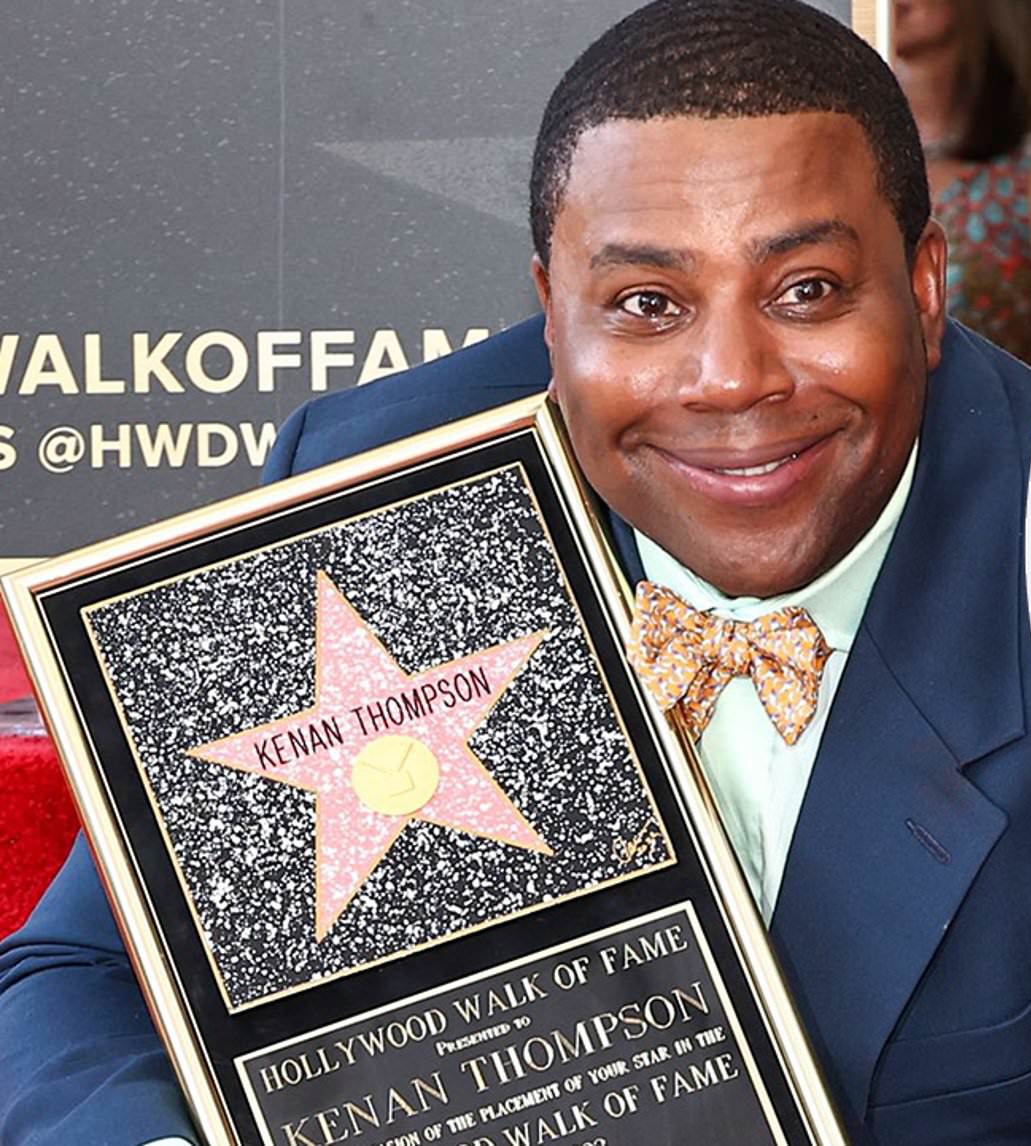
Thompson received a star on the Hollywood Walk of Fame for his work done in television. The ceremony was held on August 11, 2022 and honored Thompson with the 2,728th star located at 6627 Hollywood Boulevard.

Friday, December 27, 2019

"Rugrats in Paris" Celebrates It's 20th Anniversary In 2020 As We Remember It's "ChatBack" Watches!


November 17, 2020 will mark the 20th Anniversary of the release of the Rugrats in Paris film which premiered in theaters on November 17th in 2000 in the United States.

The animated feature released by Paramount and Nickelodeon made $103 million at the box office after being made with a budget of $30 million and saw a cool $20 million spent in promotional efforts towards the films success including toys in kids' meals at fast food restaurants.


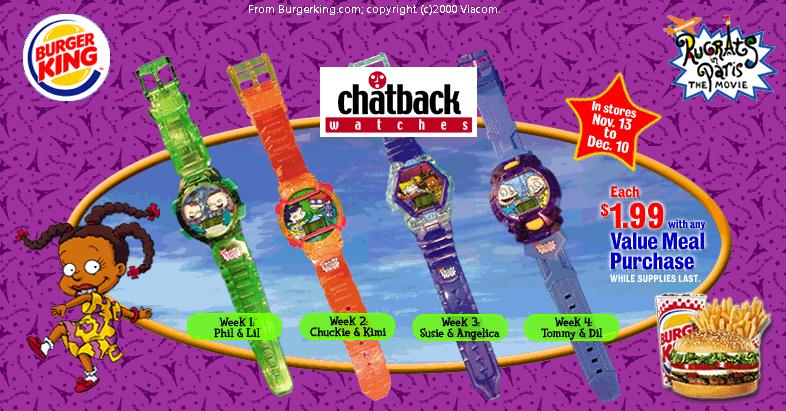
From 11/13/2000 to 12/10/2000, Burger King promoted Rugrats In Paris. During the promotion, Burger King offered 4 special "ChatBack" watches, with each watch featuring a mini-conversation between 2 Rugrats. One watch was released per week, and sold for US$1.99 with any value meal purchase.

The four were made exclusive for a limited time only. It's safe to say that during this period only a certain demographic of children (now known as Millennials) got to experience and take part in this promotional blitz as a consumer which is now engraved into their bedded memories as apart of nostalgia.


The watches were uniquely and brilliantly designed in bold, vibrant colors ranging from lime green, purple & clear, deep sea blue and orange. When activated, the Rugrats characters "chat back'' to each other using phrases inspired by the movie. Each watch featured a "conversation'' between two different Rugrats characters with the press of a button. It's wrist bands were made of thick rubber that was tough to break. Aside of the character features it was easy to tell time with for child or an adult. Each watch was fun, family-friendly and uniquely designed in their own way.

THERE WERE 4 WATCHES FEATURED: (Pictures from Burger King's website; all ©2000 Burger King & Viacom.)


Phil & Lil (green watch) - released week 1

Phil: It's an alien!
Lil: It's Reptar!
Phil: Wow!
Lil: This is great!

Kimi & Chuckie (orange watch) - released week 2

Chuckie: It's a 'moozement park!
Kimi: That's scary!
Chuckie: You're not too brave.
Kimi: I'm not goin'!

Angelica & Susie (purple watch) - released week 3

Susie: I'm gonna sing!
Angelica: Now what?
Susie: Listen to me!
Angelica: Don't interrupt.

Tommy & Dil (blue watch) - released week 4

Tommy: Wanna play, Dilly?
Dil: My Tomby!
Tommy: Let's do it!
Dil: Play! Play!

Unlike any other wrist watch that has ever been made. Not your average Rolex but a contemporary competitor of such in its own right. Something to remember when November 17, 2020 pops up on the calendar.